
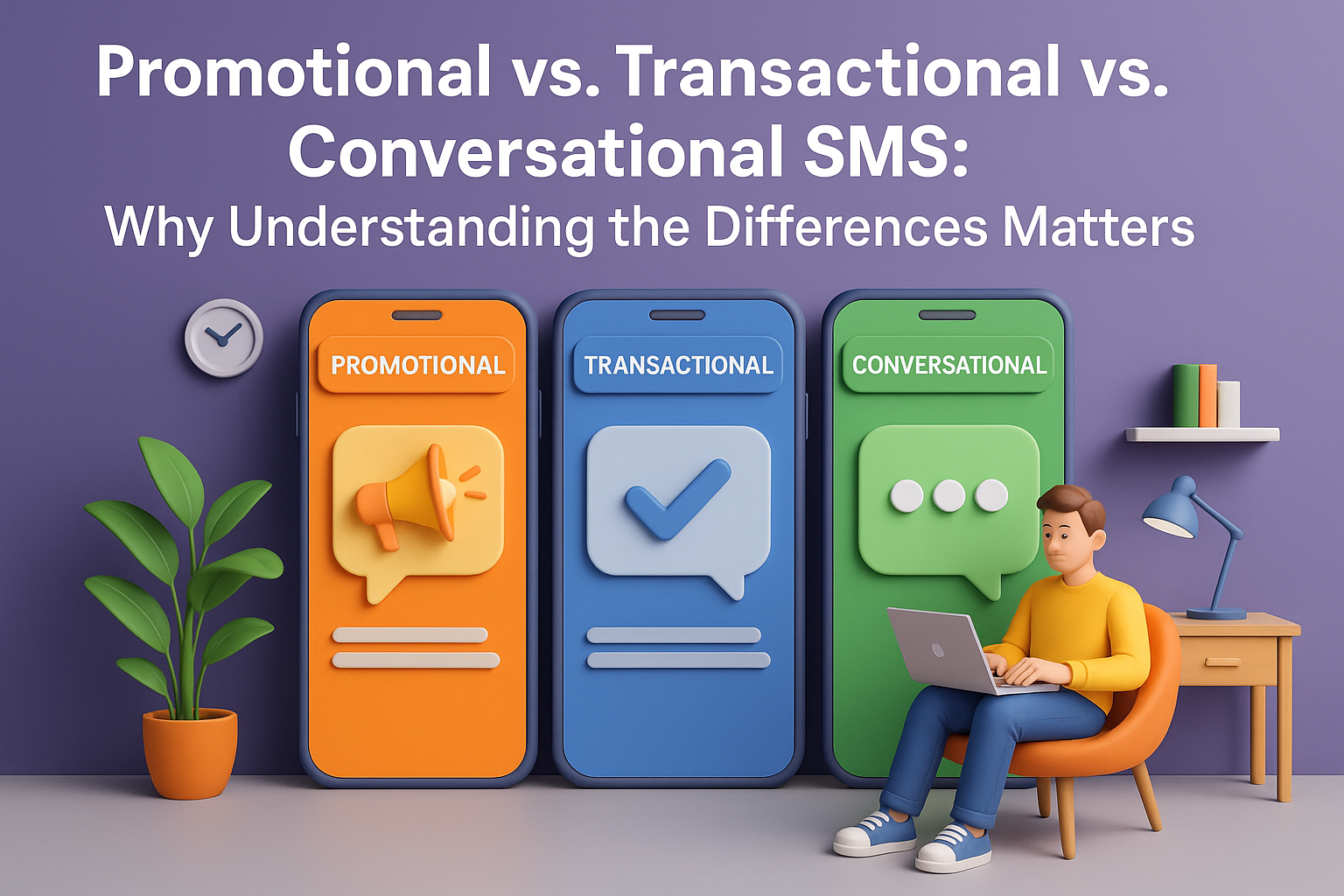
Promotional vs. Transactional vs. Conversational SMS: Why Understanding the Differences is Matters
The sender nature of the messages that you want to send is an important step in developing a successful SMS marketing strategy. It assists in making sure you do not violate any regulation; besides, it eliminates chances of ignoring your messages, deleting or even annoying your customers.
SMS marketing has also turned out to be a giant force for all businesses, however big. It is quick, intimate and very efficient. Did you realise that 98 per cent of SMS messages are read, whereas only 20-30 per cent of emails are opened? That's a huge difference.
Businesses are leveraging this immediacy to:
- Promote sales and special offers
- Remind customers about appointments
- Provide one-on-one customer service
It is logical – in the world where every individual looks into his phone 30-40 times daily, SMS is one of the most straightforward means of contacting them. But this is the twist to it all: other messages are not created similarly. Sending the incorrect kind of SMS may backfire, leading to low levels of engagement, irritated customers or even legal difficulties.
Hence the need to know the difference between promotional, transactional and conversational SMS. Do something right and you will see improved performances and customer satisfaction. Make a mistake and your campaigns may not take off.
What Are Promotional SMS Messages?
Promotional SMS messages are your marketing superheroes. Their main goal? To advertise products, services or events, sell more, and attract attention. They tend to be messages that are sent to a high volume of customers, and it is a one-way communication, i.e., you send it but do not expect a response.
Examples of Promotional SMS
- “Diwali Sale Alert! Get 30% off all electronics. Shop now: [link]”
- “Check out our new skincare collection today! Click here: [link]”
- “Limited-time flash sale — don’t miss out!”
Consider promotional messages a megaphone for your brand. You desire people to pay attention, to click, to do something, be it to buy or to join an event.
Why You Need Consent
There is the tricky part here; you cannot text anyone. There has to be written consent for promotional messages. That is, they need to expressly consent to accept marketing texts from your customers, whether online, in a written form or through an audio or video recording. You cannot assume consent.
Pro Tip: Be brief, direct and to the point in promotional messages. Add a direct call to action, such as “Shop Now” or “Claim Offer,” and deliver them at a time when clients might be most interested.
What Are Transactional SMS Messages?
Transactional SMS messages are more like your friendly assistants. They contain the data required by customers to make their purchase, follow an order, or consume a service. These are not marketing but informative and generally one-directional, unlike promotional texts.
Examples of Transactional SMS
- “Your order #56789 has been shipped. Track it here: [link]”
- “Use 8729124 as your Microsoft account password reset code.”
- “Your appointment with Dr Sharma is confirmed for tomorrow at 10 a.m.”
Informational messaging is known as transactional messages, in which the customer will provide permission to share the number to be used to achieve a particular goal, such as a delivery notification or appointment notification.
Important: Authorisation of the transactional texts does not necessarily encompass promotional messages. As an example, when a customer leaves his or her number to monitor the order, you cannot offer them marketing messages without their direct consent.
Pro Tip: Keep transactional messages short and to the point, and include only the necessary information. Avoid adding marketing language, as it can lower customer trust.
What Are Conversational SMS Messages?
Two-way communication is the magic of conversational SMS where communication occurs. The customer initiates these messages, and your business can reply in real time, respond, or answer questions. Imagine it was a text conversation with a customer. Conversational SMS Messages.
Examples of Conversational SMS
- “When do you open tomorrow?”
- “I need to reschedule my appointment.”
- “I ordered last week but haven’t received it yet. Can you help?”
Conversational messages are based on implied consent, as it is the customer who initiates the conversation. The response of your business only presents the necessary information, and it is possible to speed up and personalise these interactions using automation tools such as chatbots or CRM integrations.
Pro Tip: Address your customer by name, purchase history or past engagements. Messages must be friendly and human, even if automatised, because nobody likes a robot answer.
Why These Differences Matter
Consumer approval is the most fundamental element of SMS marketing. The regulations vary on the kind of message:
- Promotional: Requires express written consent.
- Transactional: Requires express consent for specific informational purposes.
- Conversational: Implied consent is used since the customer made the first contact.
Any misplaced message or even the assumption of consent can harm communication, irritate customers and even cause a lawsuit. Alternatively, awareness of these differences will help to communicate effectively, develop trust and increase ROI.
Key Takeaways
- Promotional SMS: Increased sales and awareness. Needs to express written consent.
- Transactional SMS: Posts key updates. Needs express consent for informational purposes.
- Conversational SMS: Two-way communication, initiating loyalty. Uses implied consent.
- Consent is never universal — permission for one thing does not apply to another thing.
- Confusion of message types without knowing the intent can make the message less trusted and appreciated.
Final Thoughts
SMS marketing is not just about sending messages, but it is about communicating with your audience in the right manner. Promotional, transactional and conversational messages will be put through strategic utilisation where immediate engagement is facilitated, customer support is offered more, and loyalty is maintained in the long term. It is quite simple to use SDGM Technologies, as a business can easily control all types of SMS with our intelligent, legally compliant, and easy-to-use automations.
We assist you in communicating effectively and efficiently to your audience, whether you are doing a seasonal promotion, updating the customer on their order, or offering real-time customer support.
We can help you jumpstart your SMS marketing today – and then you will see your customer interactions and loyalty take off. Advertise