
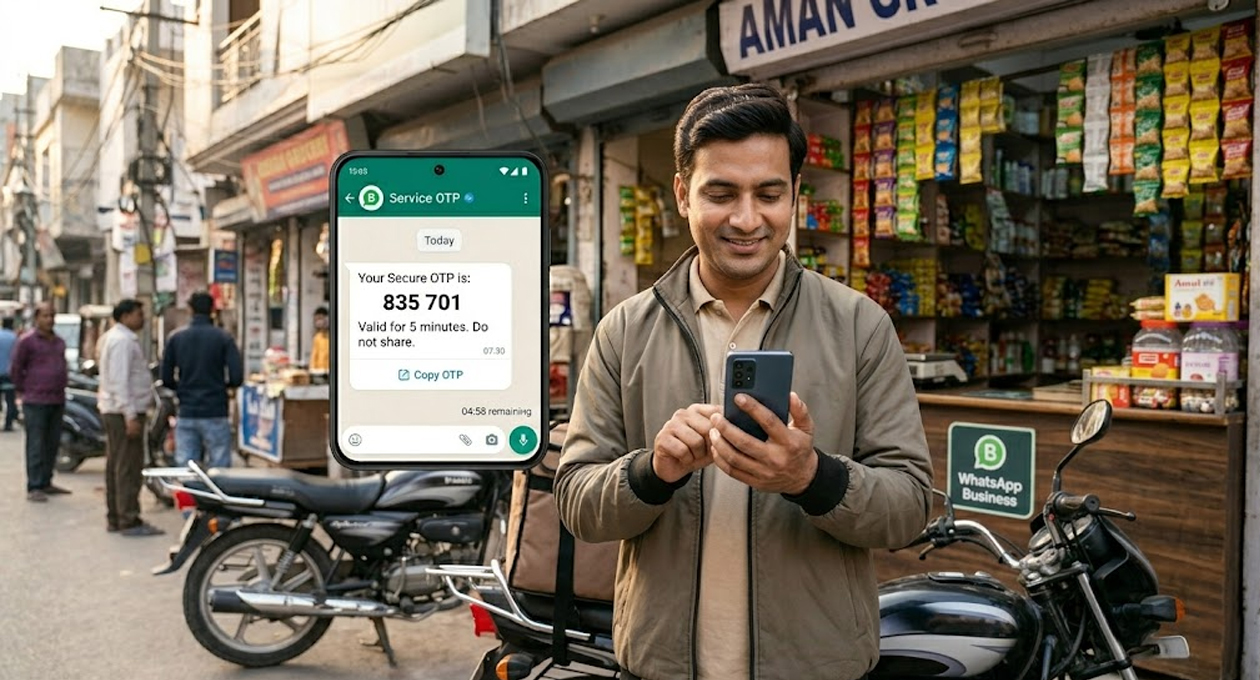
What Are the Benefits of WhatsApp OTP Messages?
The customer is trying to pay but gets stuck waiting for the OTP to arrive. The OTP fails to reach the user by then, and the user is no longer logged in. Attempts fail, wait times are long, and the user leaves. This is not a rare edge case.
The delays caused by SMS OTPs, the carrier filters, and failure to receive SMS messages result in loss of actual business. WhatsApp OTP messages solve this problem and are behind the improved processes of businesses that use WhatsApp for verification.
What a WhatsApp OTP Is?
An OTP sent on WhatsApp refers to an authentication password, which is sent using WhatsApp rather than via SMS or email. This refers to a single-use password sent for authentication purposes so as to confirm that the individual logging in is who they claim to be.
The process is simple enough. The occurrence that will require verification may be anything, such as logging into accounts, creating an account, or making a transaction, among others. The software program will generate a verification code and send it using the WhatsApp Business API to the particular user's WhatsApp thread. The user logs into WhatsApp, views the code, and uses the code for verification purposes.
The Key Benefits of WhatsApp OTP Messages
Faster Delivery That Prevents Drop-Offs
WhatsApp OTP message delivery is normally done within a matter of seconds once the process starts. Fast delivery of the message is not a separate facility. It will rather determine whether the customer takes any action or not.
If an OTP is delivered within seconds, the user will stay with the verification process. If an OTP takes time to arrive, users will begin refreshes, request resends, and ultimately give up on the process. In e-commerce checkout, bank transactions, and mobile application registrations, where the user's attention is extremely limited, the speed of OTP delivery is crucial.
End-to-End Encryption for Stronger Security
Texts go through the carriers' network and can be tapped using SIM swapping, SS7 protocol attacks, and carrier weaknesses. WhatsApp messages containing one-time passwords (OTPs) are end-to-end encrypted when they leave the corporate infrastructure until they are opened by the customer.
Such encryption ensures that the code cannot be deciphered or intercepted during transmission, making WhatsApp a much safer method of authentication than SMS. For firms in finance, fintech, healthcare, and retail who face the ever-increasing problem of account takeover fraud, the difference is important rather than theoretical.
According to the Microsoft data, almost 99.9% of those accounts hacked did not have multi-factor authentication enabled. OTP provides the necessary protection for an account that would prevent such hacks, and WhatsApp is a safer choice than SMS for doing so.
Verified Business Identity That Customers Trust
Once an OTP has been received via SMS through an alphanumeric sender code, the recipient will not know for certain who it is coming from. Scams work on this loophole by forging sender codes.
When receiving an OTP on WhatsApp, it comes through with the name of the company verified at the top of the conversation alongside their profile picture. There is no mistaking where the code has come from. By verifying their identity, companies reduce any uncertainty or hesitation, boost completion rates, and inspire trust among users.
Read Receipts That Confirm Delivery
SMS offers organizations no insights into what transpires once an SMS is sent. Whether it was delivered successfully or whether it was ever read by its intended recipient.
WhatsApp OTPs come with full tracking capabilities, including delivery status confirmation and read receipts. In real-time, the company can track whether the SMS OTP was sent and read by the customer. The ability to monitor and track the SMS OTP helps to diagnose and solve any issues in the OTP authentication process.
Global Reach Without Carrier Limitations
International SMS transmission is costly, unreliable, and prone to routing problems between carriers, filtering at the country level, and roaming issues. WhatsApp circumvents all of these by sending messages through the internet network, not telecom carrier networks.
Companies that have clients in different countries can use WhatsApp OTPs instead of international SMS, as the former works better and is more affordable, especially if the client has an internet connection and is a WhatsApp user. It will be ideal for the operation of fintech companies, e-commerce stores, and SaaS platforms operating across borders.
Better User Experience Within a Familiar App
WhatsApp is something that people use several dozen times each day already. Getting an OTP in the same application they use to message family and work colleagues is easy, with no need to adjust or learn anything new.
Familiarity minimizes friction from having to verify in a way that standalone authenticator apps and email OTPs cannot match. The former necessitate setting up, while the latter necessitate shifting from one app to another and digging through emails. WhatsApp OTP comes through notifications familiar to customers.
What Businesses Need to Implement WhatsApp OTP
Setting up WhatsApp OTP delivery requires three things:
- WhatsApp Business API access: OTPs can only be sent via the API and not via the WhatsApp Business application. The WhatsApp Business API access is gained from an authorized WhatsApp Business Solution Provider.
- Pre-approved OTP message templates: All OTP messages should utilize pre-approved templates provided by Meta before being dispatched. Templates should not have any promotional messages, and there should be a designated place for the OTP code as well as an expiration period.
- Customer opt-in: WhatsApp needs explicit consent from all users before any messages are sent to them, including OTPs for transactions. User opt-ins are usually acquired during account creation or the onboarding process.
One Essential Safety Net: Fallback Delivery
WhatsApp OTP requires an active internet connection and a WhatsApp account. In cases where the customer is unable to get an active internet connection, uses an unregistered number, and has no WhatsApp account, OTP delivery will not be possible.
Any company using WhatsApp for OTPs must provide an automated backup in the form of SMS or voice-based OTPs in case WhatsApp does not deliver the message. The process works by detecting that the OTP has not been delivered successfully via WhatsApp and immediately switches to another method of delivery within a few seconds.
Conclusion
Each missed OTP means each missed transaction. Each time the user receives an email containing the verification code late, the client has already closed the browser window and gone elsewhere. Those enterprises that are truly concerned about authenticating their clients do so at a point in time when those same clients are most prepared to conduct their business.
SDGM Technologies offers WhatsApp Business API services to businesses in India. We offer services such as creating OTP templates, integrating the API with the authentication and payments system, configuring fallback SMS, and providing live delivery analytics so that customers are never left stranded in achieving their objectives.
FAQs
Q: Is WhatsApp OTP more secure than SMS OTP?
Yes. The WhatsApp messages can be considered end-to-end encrypted and travel over the Internet rather than the GSM network, which can be easily attacked via SIM cloning and SS7 exploits.
Q: What happens if a customer does not have WhatsApp?
The process of sending the code will fail if the phone number of the recipient is not registered within WhatsApp. The provision for an automatic fallback to SMS or telephone call becomes necessary in such situations.
Q: How long is a WhatsApp OTP valid?
Most businesses set OTP validity between 30 and 90 seconds. Short expiry windows reduce the risk of the code being misused if it is delayed or intercepted.
Q: Does WhatsApp OTP require customer opt-in?
Yes. WhatsApp requires explicit consent from every recipient before any message, including OTPs, can be sent through the Business API.
Q: Can WhatsApp OTP be used for financial transaction authentication?
Yes. It is widely used by banks, fintech platforms, and e-commerce businesses for payment confirmation, fund transfer approval, and high-value transaction authentication.